
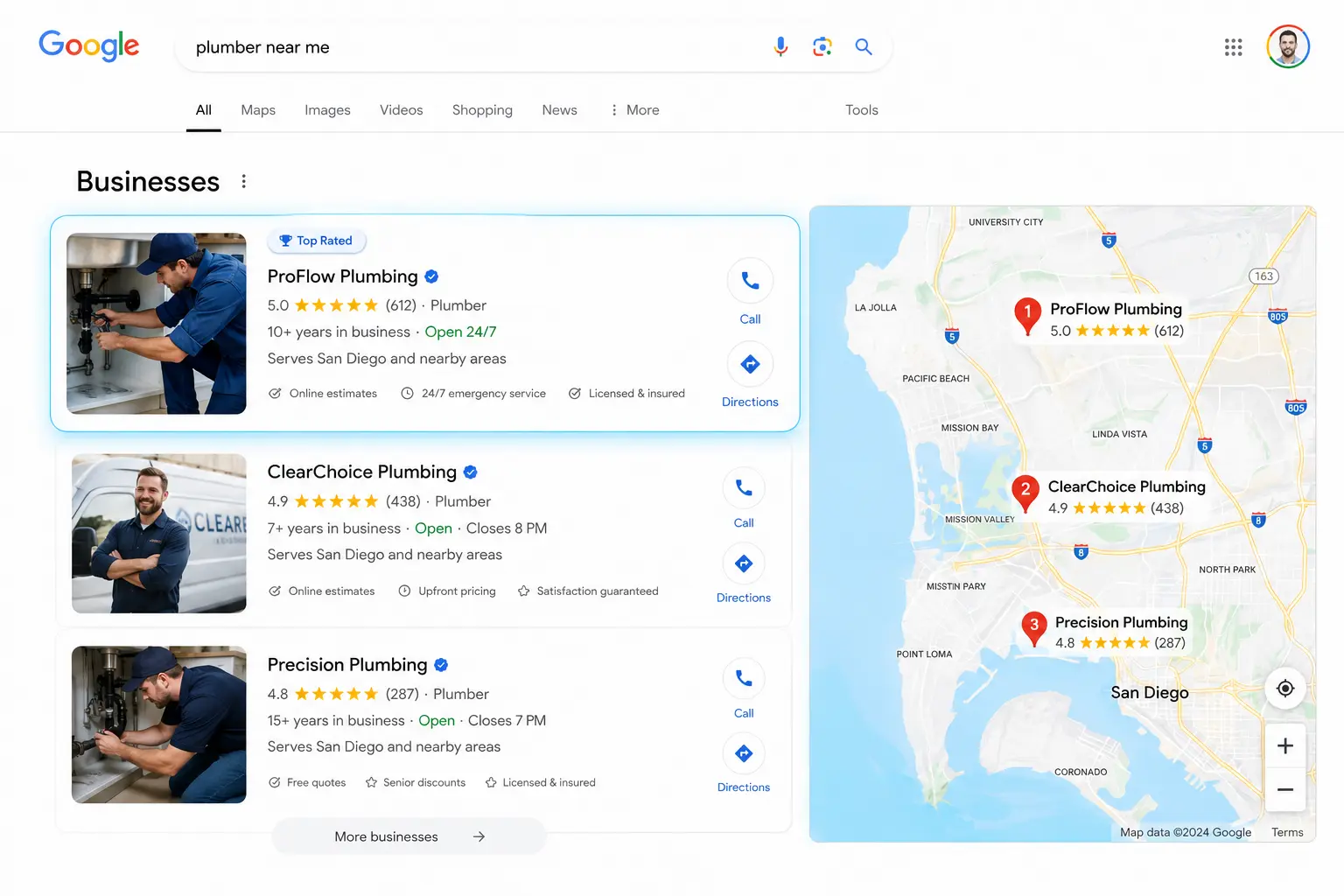
Most small businesses spend thousands on ads and get little in return. Meanwhile, their competitors quietly climb Google rankings and collect free, high-intent traffic every single day. A solid small business SEO checklist is the blueprint that changes this.
Whether you run a local bakery, a service-area plumbing company, or an early-stage startup, SEO gives you a compounding advantage that paid ads can never match. This guide breaks down every critical step from Google Business Profile to AI Search optimization so you can build rankings faster and smarter in 2026.
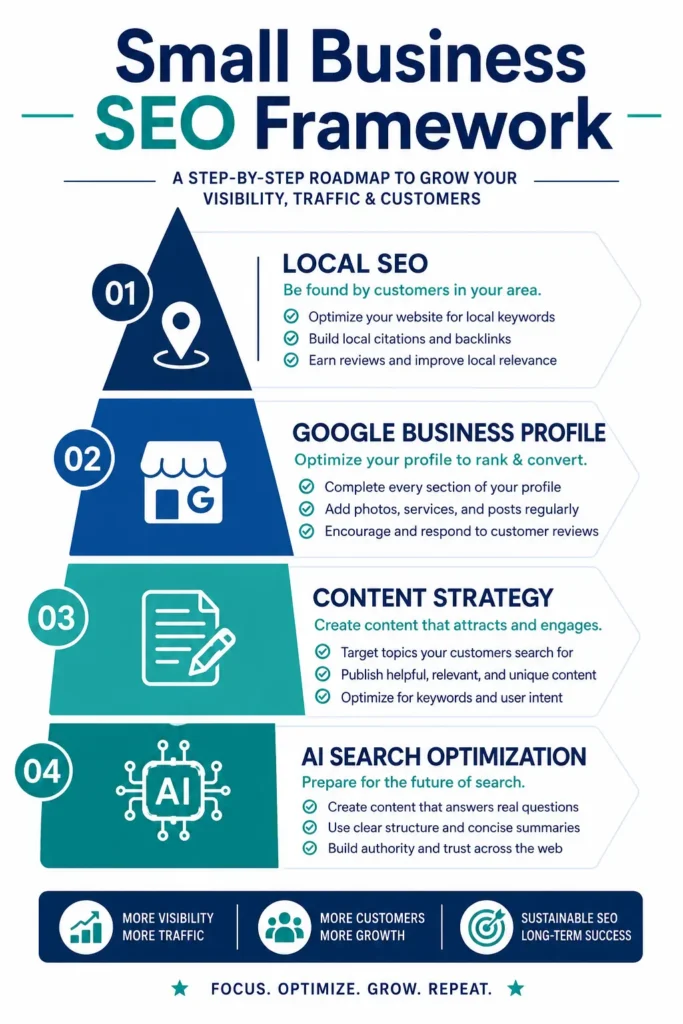
Why Small Businesses Need SEO in 2026
Search behavior has shifted dramatically. Google’s AI Overviews now summarize answers directly in search results. Platforms like ChatGPT, Perplexity, and Bing Copilot are sending traffic to sources they trust. Local Pack results and Google Maps dominate mobile searches above everything else.
If your business isn’t visible in these channels, you’re invisible to the customers who are actively looking for you.
Traffic Source Comparison:
Traffic Source Cost Long-Term Value SEO Low (time + strategy) Very High compounds over time Google Ads High (pay per click) Low stops when budget stops Social Media Medium (time + tools) Medium algorithm-dependent SEO consistently delivers the highest ROI over 12–24 months. For small businesses with limited budgets, it’s not optional it’s essential.
Small Business SEO Checklist for Faster Rankings

Set Up Google Search Console and Google Analytics 4
Before you optimize anything, you need visibility into your site’s performance.
- Create and verify your property in Google Search Console
- Connect Google Analytics 4 to track traffic, conversions, and user behavior
- Submit your XML sitemap via Search Console
- Monitor the Coverage report weekly to catch crawl errors early
- Set up conversion goals in GA4 (calls, form submissions, purchases)
These two free tools are the foundation of every smart SEO strategy.
Claim and Optimize Your Google Business Profile
Google Business Profile (GBP) is the single most powerful tool for local SEO. It controls your visibility in Google Maps, the Local Pack, and increasingly in AI-generated answers.
- Claim and verify your listing at Google Business Profile
- Complete every field: name, address, phone, hours, categories, website
- Choose primary and secondary business categories carefully
- Upload at least 10 high-quality photos (interior, exterior, team, products)
- Add your services or products with descriptions and prices
- Enable Q&A and respond to all questions
- Post weekly updates using Google Posts
- Actively request reviews and respond to every one positive and negative
Businesses with complete, active GBP listings rank significantly higher in local search. This is one of the fastest wins available to any local business.
Target Long-Tail Local Keywords
Avoid broad, highly competitive keywords. Instead, focus on specific, intent-driven phrases that attract ready-to-buy customers.
- Use tools like Google’s “People Also Ask,” Keyword Planner, or Ubersuggest
- Target phrases like “emergency plumber in [city]” or “best Italian restaurant near [neighborhood]”
- Map each keyword to a specific page don’t let multiple pages compete for the same term
- Include geo-modifiers naturally in title tags, headers, and body copy
Long-tail local keywords convert at a higher rate and are far easier to rank for than generic terms.
On-Page SEO Checklist for Local Businesses
On-page SEO ensures Google understands exactly what each page is about. Here’s what every page on your site needs:
- Title Tag: Include the primary keyword and city/region. Keep it under 60 characters.
- Meta Description: Write a compelling 150–160 character summary with a clear benefit and call-to-action.
- H1 Heading: One per page. Include your primary keyword naturally.
- H2 and H3 Subheadings: Break content into scannable sections. Include secondary keywords.
- Internal Links: Link to related service pages and blog content. Distribute link equity across your site.
- Image Alt Text: Describe every image with relevant, keyword-aware text. Don’t stuff — just be descriptive.
- URL Structure: Short, clean, and keyword-inclusive (e.g., /services/roof-repair-chicago/)
- Word Count: Match or exceed the content depth of top-ranking competitors for each target keyword.
Technical SEO Checklist for Small Business Websites
Technical SEO ensures search engines can crawl, index, and rank your pages without friction.
Technical SEO Quick Reference:
| Factor | What to Check | Tool |
| Mobile-Friendly | Passes Google’s Mobile-Friendly Test | Search Console |
| Core Web Vitals | LCP, INP, CLS all in “Good” range | PageSpeed Insights |
| HTTPS | SSL certificate active site-wide | Browser + Search Console |
| Schema Markup | LocalBusiness, FAQPage, Review schema added | Schema.org + Rich Results Test |
| XML Sitemap | Submitted and error-free in Search Console | Search Console |
| Robots.txt | Not blocking important pages | robots.txt checker |
| Broken Links | Zero 404 errors on crawled pages | Screaming Frog / Ahrefs |
Fix technical issues before investing heavily in content. A slow, insecure, or poorly structured site undermines all other SEO efforts.
Local SEO Checklist for Multi-Location and Service Businesses
Local SEO goes beyond your website. Your business’s consistency and reputation across the web directly affect your Google Maps rankings.
NAP Consistency
Your Name, Address, and Phone number must be identical across every platform your website, GBP, Yelp, Facebook, and every directory. Even small inconsistencies confuse Google and hurt rankings.
Local Citations and Business Directories
- List your business on top directories: Yelp, Bing Places, Apple Maps, Yellow Pages, BBB
- Use industry-specific directories relevant to your niche
- Audit existing citations with tools like BrightLocal or Whitespark
- Remove or correct duplicate and inaccurate listings
Reviews and Reputation
Reviews are a top local ranking signal. Build a system for consistently collecting them.
- Ask satisfied customers directly via text or email
- Add a review request link to invoices, receipts, and follow-up emails
- Respond to every review within 24 hours
Location Pages for Service-Area Businesses
If you serve multiple cities or neighborhoods, create dedicated location pages for each area. Each page should include unique content, local keywords, a map embed, and location-specific testimonials.
At BusinessViaSEO, we specialize in building this kind of geo-targeted infrastructure for service businesses and multi-location brands driving measurable improvements in Google Maps rankings and Local Pack visibility.
AI Search Optimization and GEO for 2026
Generative Engine Optimization (GEO) is the new frontier. Google’s AI Overviews, ChatGPT, Perplexity, and Bing Copilot are generating answers from trusted, well-structured web sources. If your content isn’t optimized for these platforms, you’re missing a growing share of search traffic.

How to optimize for AI Search:
- Structure content for direct answers. Use clear question & answer formats. Concise, factual responses get cited more often.
- Add schema markup. FAQPage, HowTo, and LocalBusiness schema help AI engines understand your content’s context.
- Strengthen EEAT signals. Include author bios, credentials, case studies, and real customer reviews. AI models favor authoritative, trustworthy sources.
- Build entity associations. Consistently mention your business name, location, and core services across high-authority platforms to help AI models associate you with specific topics.
- Earn citations from trusted sources. Links and mentions from industry publications, local news, and established directories directly improve AI search visibility.
Learn more about the evolving SEO landscape on the BusinessViaSEO blog.
How long does local SEO take?
Most local businesses see meaningful improvements in 3–6 months. Competitive markets may require 6–12 months of consistent effort. Technical fixes and GBP optimization often produce faster initial gains.
Why is Google Business Profile important?
Google Business Profile controls your visibility in the Local Pack and Google Maps the first results most mobile users see. A fully optimized GBP listing can drive significant call and foot traffic without any ad spend.
What is the difference between SEO and GEO?
SEO (Search Engine Optimization) focuses on ranking in traditional search results. GEO (Generative Engine Optimization) focuses on getting your content cited and featured in AI-generated answers from tools like Google AI Overviews, ChatGPT, and Perplexity.
How do I rank higher in Google Maps?
The top factors are: a complete and active Google Business Profile, consistent NAP information across all directories, a strong volume of positive reviews, local citations on authoritative sites, and proximity to the searcher.
Start Ranking – Request Your Free SEO Audit
Executing this small business SEO checklist consistently is what separates businesses that grow organically from those that stay invisible. Start with the foundations: set up Search Console and Analytics, claim your Google Business Profile, fix technical issues, and build location-specific content.
Every step compounds. Six months of focused effort will deliver results that no ad budget can replicate.
BusinessViaSEO works exclusively with local businesses, physical stores, service-area companies, and multi-location brands that want to become the first business their customers find online in Google Search, Google Maps, and AI-powered search engines.
Ready to see exactly what’s holding your rankings back? Request your free SEO audit today.