
If you run a local service business, you have probably asked this question more than once. Should you invest in SEO, or put your budget into Google Ads? Both promise more customers. Both cost real money. But they work in completely different ways, and choosing the wrong one can quietly drain your budget for months before you notice.
This article does not give you a generic marketing answer. It gives you a business answer. One built around leads, revenue, and long-term growth for service-based businesses like yours.
By the end, you will know exactly which strategy fits your situation and how to use both if the timing is right.
What Local Service Business Owners Really Need From Marketing
Most local service businesses plumbers, electricians, dentists, lawyers, HVAC contractors share the same core need. They need a consistent, predictable flow of qualified leads. Not website visitors. Not impressions. Paying customers.
Too many business owners measure marketing success by the wrong metrics. Traffic numbers look good on a report. Revenue in the bank tells the real story. Your marketing strategy should start with how your business makes money, not with what a tool can technically deliver.
That framing is essential before comparing SEO and Google Ads. Neither channel is automatically better. The right one depends on where you are, what you need, and how fast you need it.
How Google Ads Works for Local Service Businesses
Google Ads puts your business at the top of search results immediately. You pick your target keywords “emergency plumber Chicago” or “best HVAC repair near me” , set a daily budget, and your ad appears when someone searches those terms. You pay only when someone clicks.
For local businesses, Google Ads includes precise geographic targeting. You can restrict your ads to people within five miles of your location, or within specific zip codes. That precision is genuinely useful. You avoid wasting ad spend on clicks from areas you do not serve.
The biggest advantage of Google Ads is speed. You can launch a campaign in the morning and get phone calls by afternoon. That immediacy is valuable especially for new businesses, seasonal promotions, or any situation where you need revenue fast.
The Real Cost of Google Ads for Local Businesses
Speed comes at a price. Click costs vary dramatically by industry. A dentist might pay $10–$30 per click for “dentist near me.” A personal injury lawyer could pay $50–$200 per click. Home service businesses often fall in the $5–$25 range depending on local competition.
Here is what math often looks like. If your average click costs $15 and 10% of clicks turn into a call, each phone call costs $150 in ad spend. If only 30% of those calls convert to a booked job, your cost per new customer is $500. Whether that is profitable depends entirely on your average job value.
The critical problem with Google Ads is sustainability. The moment you pause or stop your campaign, the leads stop. Completely. You own nothing in the end. Every pound or dollar spent on ads buys temporary visibility, not a lasting asset.
How Local SEO Builds a Revenue-Generating Asset
Local SEO is the process of making your business the obvious answer when someone searches for your service in your area. That means optimizing your Google Business Profile, building accurate citations across directories, earning positive reviews, and creating location-specific pages on your website.
When local SEO works, your business appears in the Google Map Pack the three businesses shown at the top of local search results. That placement generates clicks, calls, and bookings without any per-click cost. The traffic is genuinely free once you earn the ranking.
Unlike ads, SEO builds compounding value over time. A well-optimized service page can rank and generate leads for years after the initial work is done. That is the core difference. You are building an asset, not renting visibility.
Why Local SEO Converts Better Than Most Business Owners Expect
Users trust organic results more than paid ads. Many people actively scroll past sponsored listings to find organic results. They perceive organic rankings as a signal of credibility and relevance, a natural recommendation from Google rather than a paid placement.
For service businesses where trust matters healthcare, legal, home services this trust factor translates directly into higher conversion rates. A law firm ranking organically for “personal injury attorney near me” appears more credible than one running ads for the same term. Earned visibility signals expertise in a way that paid advertising cannot replicate.
How Long Does Local SEO Take to Deliver Results?
This is the most common objection and a fair one. Most businesses start seeing meaningful movement in three to six months. Competitive markets or large cities may take longer. Initial wins from Google Business Profile optimization and citation cleanup can appear within a few weeks, but building consistent top rankings takes sustained effort.
The timeline is real. SEO is not the right choice if you need leads this week. But for businesses thinking beyond the next 90 days, the compounding return makes SEO the stronger long-term investment by a significant margin.
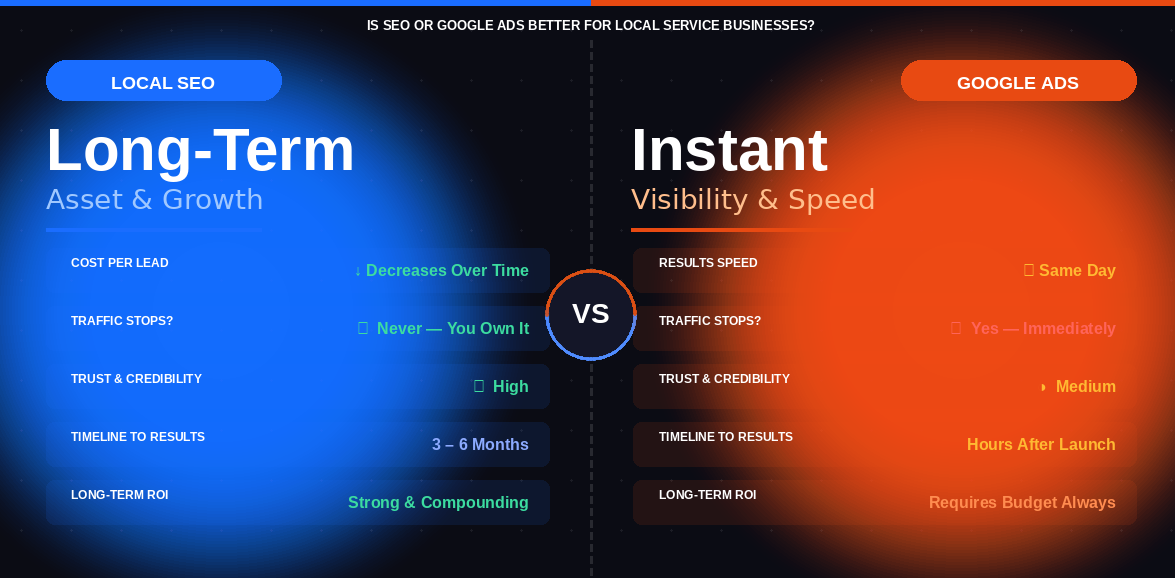
SEO vs Google Ads: Side-by-Side Comparison for Local Businesses
| Factor | Local SEO | Google Ads |
| Time to Results | 3-6 months | Same day |
| Cost Structure | Upfront investment; low ongoing cost | Ongoing spend required |
| Traffic After You Stop | Gradually declines | Stops immediately |
| Trust & Credibility | High organic results feel earned | Lower marked “Sponsored” |
| Targeting Control | Limited algorithm-dependent | Precise location, time, device |
| Long-Term ROI | Strong and compounding | Dependent on continuous budget |
| Best For | Sustainable lead generation | Fast results and market testing |
| Scalability | Scales with content and authority | Scales with budget |
When Google Ads Is the Right Choice for Local Businesses
Google Ads makes clear business sense in specific situations. Recognize them early so you do not overpay for something that does not match your needs.
You are newly open and need customers fast. A new HVAC company cannot wait six months for SEO rankings. Google Ads bridges that gap and keeps cash flowing while your local SEO foundation builds in the background.
You are testing a new service area or new offering. Before investing months in SEO content for a service you are not sure about, run a Google Ads campaign to validate demand. If the clicks convert, you have confirmed the market. If they do not, you saved yourself months of wasted SEO effort.
Your competitors dominate organic results. In markets where established businesses own the top organic positions, Google Ads provides visibility you cannot organically achieve quickly. It keeps you competitive while you build long-term SEO authority.
You are running a time-sensitive promotion. Seasonal demand, limited-time offers, or event-based services benefit from the instant reach that paid advertising provides. SEO cannot react in real time Google Ads can.
When Local SEO Is the Smarter Investment
SEO wins when you are thinking beyond the next quarter. For most established local service businesses, the economics favor SEO over time often dramatically.
You want leads that do not stop when your budget does. Every dollar spent building local SEO authority continues paying dividends after the initial investment. A well-ranked service page for “emergency plumber in [city]” generates leads month after month with no per-click cost.
Your ad costs are eating your margins. If your cost per acquired customer through Google Ads is close to or exceeding your average profit per job, the campaign is unsustainable. SEO offers a path to leads that do not directly compete with your profit margins.
You serve a specific city or service area consistently. Local SEO is purpose-built for this scenario. Google Business Profile optimization, local landing pages, and citation building create a local presence that compounds with every review and backlink you earn.
You want to reduce dependence on paid platforms. Ad platforms change pricing, policies, and algorithms. A business that owns its organic rankings is far less vulnerable to those shifts. SEO creates independence that Google Ads never can.
The Smartest Strategy: How to Use Both SEO and Google Ads Together
The strongest local marketing approach uses both channels, but with clear purpose for each. Start with Google Ads to generate immediate revenue while simultaneously building your local SEO foundation. Over time, shift the balance.
As your organic rankings improve and generate consistent leads, gradually reduce your Google Ads spend. Redirect those savings into maintaining and expanding your SEO gains. The goal is moving from renting visibility to owning it.
Use your Google Ads data to sharpen your SEO strategy. The search terms that convert in your ad campaigns tell you exactly which keywords bring paying customers — not just browsers. Build your SEO content around those proven terms.
This integrated approach reduces your long-term marketing costs, increases your lead quality, and builds a business asset that keeps growing. It also gives you resilience. If one channel underperforms temporarily, the other keeps leads flowing.
External Resource: Google Ads Help Center Local Campaigns
Is SEO or Google Ads better for small local businesses?
For most small local businesses, SEO delivers better long-term ROI. Google Ads works faster but requires continuous spending to maintain results. SEO builds a lasting asset that generates leads without per-click costs. If the budget is tight, prioritize SEO. If you need leads immediately, use Google Ads while building your SEO foundation.
How much does Google Ads cost for local service businesses?
Costs vary by industry and location. Home service businesses typically pay $5–$25 per click. Dental and medical keywords average $10–$30. Legal and financial terms can exceed $50–$200 per click. Most local businesses spend $500–$2,000 per month on Google Ads for meaningful results.
How long does local SEO take to show results?
Most local businesses see measurable improvements within three to six months of consistent SEO effort. Highly competitive markets or large cities may take longer. Google Business Profile optimization and citation cleanup can produce early wins within a few weeks, while ranking authority builds over several months.
Does Google Ads help with organic SEO rankings?
No. Google has confirmed that paying for Google Ads does not improve your organic search rankings. Paid ads and organic results are separate systems. Running Google Ads does not give your website any advantage in organic search.
Which generates better leads, SEO or paid ads?
Both can generate strong leads, but the quality often differs. SEO leads tend to trust the business more before contacting them, which can lead to higher conversion rates. Google Ads leads are often more immediate but may require more nurturing. The best lead quality for your business depends on your industry, messaging, and how well your landing pages convert.
The Bottom Line: Make the Decision That Grows Your Business
SEO and Google Ads are not rivals, they are tools. The question is never which one is objectively better. The question is which one fits your current situation, budget, and growth goals.
If you need customers this week, start with Google Ads. If you are building a business that generates consistent, predictable leads for years, invest in local SEO. If you can do both, integrate them strategically and let each channel do what it does best.
What does not work is cheap SEO that never delivers results, or ad campaigns that bleed your budget without a clear return. Your marketing spend is a business investment. It should grow your revenue or it should not exist.
If your phone is not ringing and your calendar is not filling up, the strategy is not working. Demand better from your marketing and build something that lasts.